Artworks and writing created for Incidentals at Bell House. May 2025.

Hex Key. 2025. Mixed media: plastic bag, metal hex key, tarot card, A3 printed publication.
Introduced by Carl Jung, enantiodromia refers to the tendency of things to change into their opposite. In this context, the transit of artworks from intentional to incidental and back again. Incidentally, the theme is also inherently forgiving for what we might term a Re-emerging Artist.

‘an occasional will to stupidity’. 2025. Mixed media: 3D printed bust, paper bag, oil.
Curatorially, the arrangement of artworks in a space is rarely the byproduct of another now absent process, but can respond to the incidental – a room’s architectural features or the audience, for example. In this context, attempts at evoking the incidental are a kind of theatrical sleight of hand – the audience knows it’s a trick, but derives pleasure from participating in its performance.
Incidental art could emerge from a material process of making, a negative space left by an absent artwork – a kind of residue that hints at the work and now stands in its place. As my practice isn’t rooted in materials, my response to the theme has been a playful engagement with the transit of objects and ideas from intentional to incidental and back again.
By invoking the incidental I am embracing contradictions. To better do this, I’m assuming the role of The Magician from the tarot’s major arcana. The history of this card alludes to the contradictory character of the figure of the magician in western culture. In the 17th c. Marseille Tarot, the number one card of the major arcana is ‘Le Bateleur’ or the swindler. Later, the figure is known as The Juggler (clown), The Magus (wizard) and The Magician (sorcerer or stage magician).
This card embodies the idea that there is something of the trickster inherent in this archetype, something funny or stupid, but crucially that the magic he performs manifests in the world in tangible if unpredictable ways. Furthermore, there is something central about this contradictory archetype to current debates about a crisis in masculinity for younger men, and the problematic figures past and present who participate willingly or unwillingly in these often impoverished discourses.
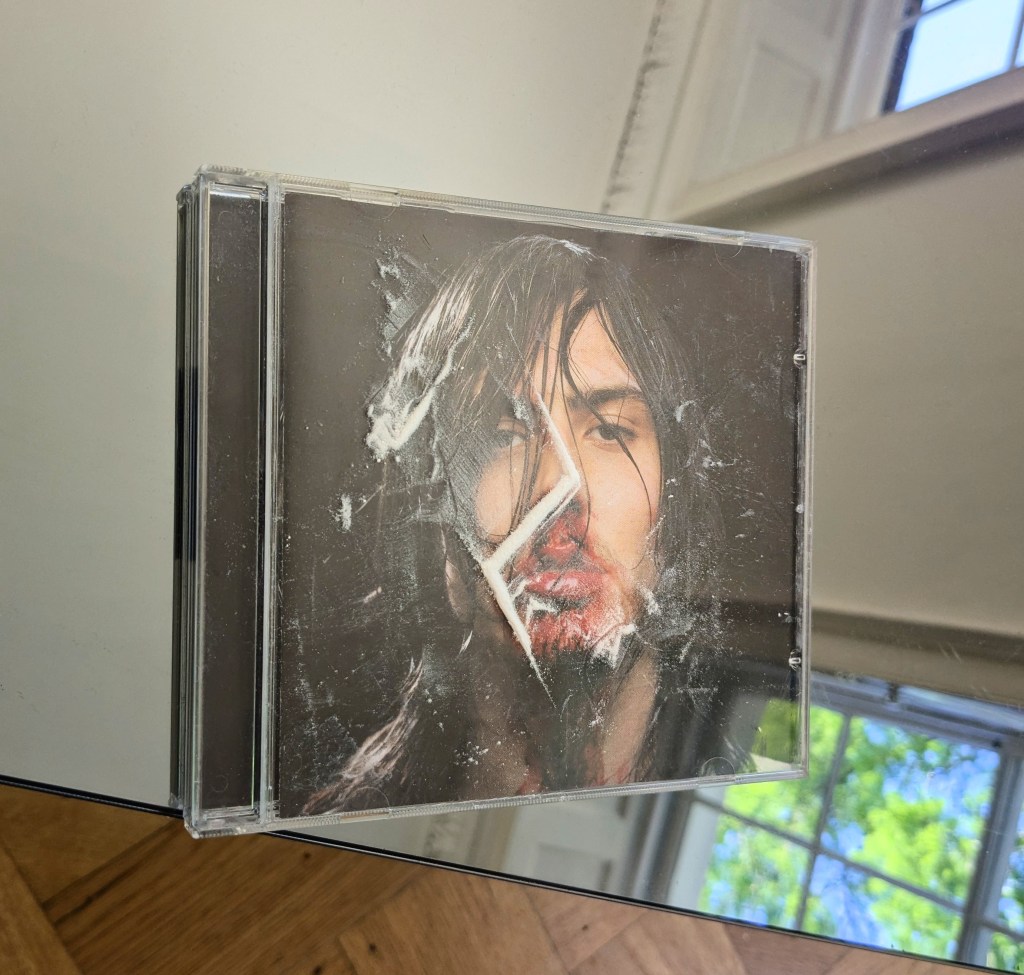
Tate. 2025. CD case, icing sugar.
When the tarot is viewed as a linear journey or story, The Magician is only one step removed from The Fool (the zero or unnumbered card of the major arcana) and a little knowledge can be a dangerous thing.
South London painter and occultist Austin Osman Spare (1886 – 1956) is perhaps now best known as the father of sigil magic, which was later developed and incorporated into Chaos Magic – a DIY, postmodern magical system that emerged alongside punk in the late 1970s.

Detail from publication. Hex Key. 2025.
What is less well known about Spare is that he painted his own tarot deck, including all 78 cards of the major and minor arcana, and intriguingly a 79th card – The Inquirer. In the recent Tarot – Origins & Afterlives exhibition at the Warburg Institute in London, The Inquirer card was presented as a source of some mystery, its precise use having been lost.
While we can fruitfully speculate on the meaning and use of Spare’s enigmatic addition to the tarot, it retains an aura of mystery and flavour of the incidental. Here, it is reproduced and placed alongside an IKEA ‘Allen’ or ‘Hex’ key – the oft leftover yet crucial component of DIY flatpack furniture.
 Will Cenci